
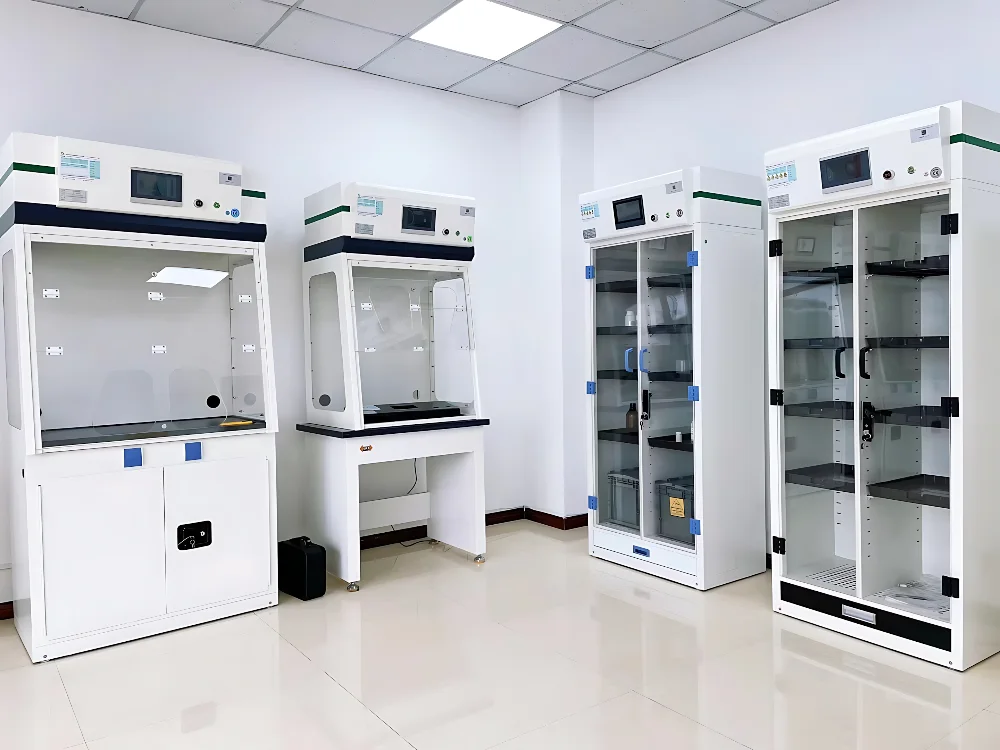
The Core Role Of Fume Hoods
Fume Hoods Are Not Only “Exhaust Equipment”, But Also a Safety Barrier For Chemical Experiments. The Main Functions Include:
Harmful gas control :
timely discharge of volatile chemicals (such as acid mist, organic solvent vapor).
Explosion-proof protection:
avoid flammable gas accumulation and explosion (such as ether, hydrogen).
Physical isolation:
prevent splashing or uncontrolled reaction from harming the operator (such as strong acid and strong base reaction).
Clean environment maintenance:
reduce cross contamination, especially for cell culture and precision weighing.
3 major types of fume hoods and applicable scenarios
Standard fume hoods (conventional chemical experiments)
-
Features:
front window can be raised and lowered, wind speed 0.3~0.5m/s, acid and alkali resistant table.
-
Applicable:
general experiments such as organic synthesis and acid and alkali treatment.
Ductless fume hood (activated carbon filter type)
-
Features:
Built-in HEPA/activated carbon filter, no external exhaust duct required.
-
Advantages:
Flexible installation, energy saving (no air conditioning exhaust).
-
Limitations:
Filter element needs to be replaced regularly, not suitable for highly toxic substances.
-
Applicable:
School teaching laboratories, PCR experiments, etc.
Perchloric acid dedicated fume hood
-
Features:
All stainless steel lining, explosion-proof design, dedicated washing system.
-
Reason:
Perchloric acid vapor is prone to explosion when it comes into contact with organic matter and requires special treatment.
| Type | Wind speed requirement | Installation cost | Applicable scenarios |
|---|---|---|---|
| Standard type | 0.5m/s | High | Chemical synthesis, strong corrosion experiment |
| Ductless type | 0.3m/s | Medium | Low toxicity reagent, teaching laboratory |
| Perchloric acid type | 0.8m/s | Very high | Strong oxidant experiment |
Five major safety guidelines for fume hood use
Pre-operation inspection
-
Wind speed test:
Use an anemometer to confirm that the surface wind speed is ≥0.3m/s (the sticker method is inaccurate!).
-
Airflow direction:
Smoke test to observe whether it overflows (such as using dry ice).
Correct operating posture
-
Window height:
Keep the window open within the safety marking line (usually 15~20cm).
-
Item placement:
Large equipment should be ≥15cm away from the window to avoid disrupting the airflow.
Dangerous experiment specifications
-
Prohibitions:
Put your head into the fume hood (there may be residual gas even if it is turned off).
Open adjacent fume hoods at the same time (easy to cause airflow short circuit).
Emergency treatment
-
Leakage response:
Close the experiment immediately;
Activate the emergency exhaust button (if any);
Report to the safety manager.
Daily maintenance
-
Weekly cleaning:
Wipe the inner wall with a neutral reagent to avoid corrosion.
-
Annual inspection:
Professional institutions calibrate wind speed and exhaust efficiency.
Frequently asked questions about fume hoods
What should I do if the fume hood is noisy?
-
Cause:
The fan is aging or the air duct design is unreasonable.
-
Solution:
Replace the variable frequency fan, or install a muffler.
Can ductless fume hoods filter all chemicals?
- No! Only suitable for low-toxicity, low-volatility reagents (such as ethanol, formaldehyde).
-
Contraindications:
Cyanide, mercury and other highly toxic substances must use external exhaust fume hoods.
How to reduce the energy consumption of fume hoods?
-
VAV system:
Automatically adjust air volume according to window opening and closing (energy saving of more than 30%).
-
Night mode:
Reduce air speed during non-working hours.
Conclusion
Fume hoods are the “silent guardians” of laboratory safety, but many accidents are caused by incorrect use or neglect of maintenance.
Recommendations:
When purchasing new equipment:
give priority to products that meet ANSI/ASHRAE 110 standards.
In daily management:
include fume hood testing in the laboratory safety inspection list.
Interactive questions:
What problems have you encountered with your laboratory fume hoods? Welcome to share solutions!